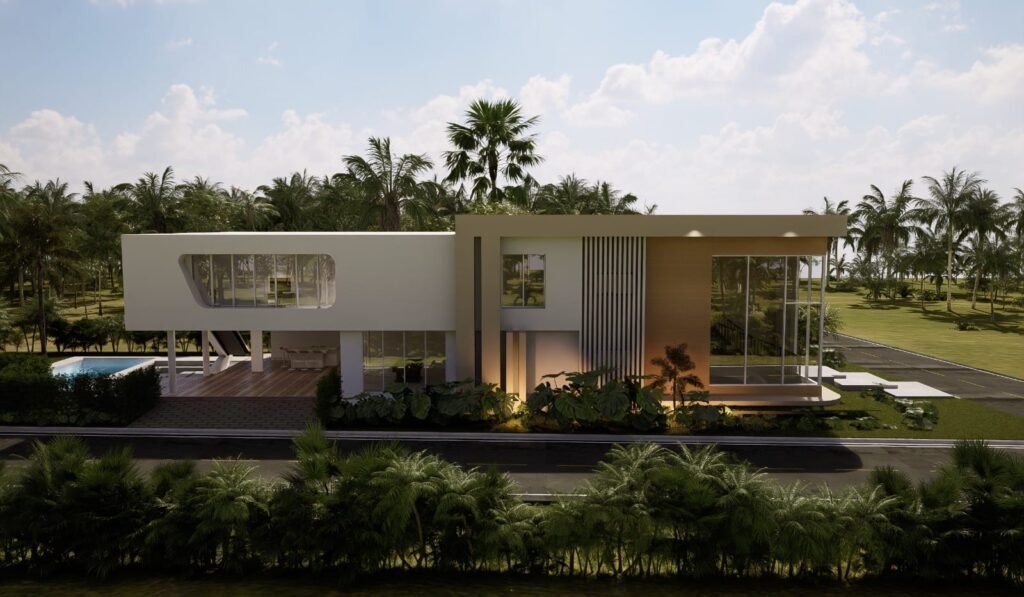
Of every question we get from clients who live abroad, the most repeated one is not what it costs. It is this: if I am three thousand kilometres away, how do I know the money I keep transferring is turning into a house?
It is a reasonable question and almost nobody answers it in writing. There is a great deal of talk about price per square metre and very little about the mechanics of payment, which is where peace of mind is actually won or lost. So let us set it out: what you pay at the start, what the rest is paid against, who certifies it, and what you should demand in writing.
The terms described here are the ones we apply in our current contracts; the final wording of each clause is set out in writing in the contract for each project.
What do you pay on signing?
On signing the construction contract you pay an advance of 20%. That money starts the work.
That it is 20% and not 50% is a deliberate decision, and the reasoning runs like this: a moderate advance lets you begin without committing a large part of the budget up front, and it leaves everything else to be paid against work already carried out and verified. The higher the advance, the more money changes hands before there is any work standing behind it. That is the whole logic of it.
What is a site measurement, and who certifies it?
This is the part that people coming from another market find hardest to follow, and it is the most important thing in this article.
After the advance, there are no fixed monthly instalments. You do not pay because a month has gone by. You pay because a specific item of work has been carried out, and only for what has actually been done. The instrument that measures it is called a cubicación — a certified site measurement.
A cubicación is a physical measurement of what has been built in a given period. The site is walked, the items that advanced are measured and quantified — so many cubic metres of concrete, so many square metres of wall, so many windows installed — and valued against the prices in the budget. The result is a document setting out what was executed and the amount that corresponds to it.
And here is the point worth demanding of any builder: that measurement is certified by the client. Nothing is invoiced against the builder’s word. It is invoiced against a document you have reviewed and approved. If an item is not finished, it does not go into that period’s measurement; it goes into the next one, when it is.
The practical effect is that payment always runs behind the work, never ahead of it. Normally that means what is pending verification at any given moment is the last period’s work, not the whole project.
Does a fixed, locked budget exist?
It is worth looking carefully at any budget presented as locked and guaranteed for 18 months, because it is hard to sustain with any precision: nobody can fix today what steel or labour will cost a year from now. When someone promises it, either the number carries a cushion inside it, or the conversation about the overrun arrives later.
What is sustainable is a firm budget with a variation clause, and a clause that states in numbers who absorbs what. In our contracts, the builder absorbs increases in materials and labour up to 5%. Above that threshold it is reviewed, and reviewed with the invoices on the table.
When you compare quotes, this is probably the clause that will save you or cost you the most money, and almost nobody reads it.
What falls outside the construction budget?
A construction budget does not include everything you are going to pay out. In our case the design is separate (deductible from the completion package), so are government fees and permits (which are not deducted from anything), and so is interior design, which is optional and quoted separately. The specific ranges for each are broken down under timelines and payments.
The important thing is not our breakdown, it is the principle: always ask what falls outside, and of that, what is deductible and what is not. A quote that does not make this clear cannot be compared with any other.
Where does the money go?
Payments are made to the company account. There is also the fideicomiso — a trust arrangement in which an independent third party holds the funds and releases them against progress. It is an available option and it is perfectly workable with clients who ask for it. What has to be said plainly is that it carries a cost and the client bears it, so the decision to use it or not is yours and is best taken with the figure in front of you.
What does the contract have to say?
The contract is where all of the above lives. These are the points that should be in writing, in ours and in anyone’s:
- Delivery date and a penalty for delay. A date with no penalty attached is an intention, not a commitment.
- A warranty on the elements in daily use, and hidden-defects cover for what does not show up until later. In our contracts the warranty runs one year; the exact scope and its exclusions are set out in the contract for each project.
- Contractor’s all-risk and public liability cover. And one line worth looking for explicitly: who answers for an accident on site. In ours, liability sits with the contractor. If that is not written down, the question gets answered very late and very badly.
- What happens if the development’s architecture committee asks for changes. This does come up in gated communities. In our contract, redesign within the original scope is covered by what has already been paid.
You can see how we have worded it in the warranties section.
Who owns the land while it is being built on?
We advise you on buying the land, but you make the transaction yourself and the title is in your name from the start. It never passes through us at any point.
This is not a small detail. It means the most expensive asset in the operation is yours before the work begins, and that your position does not depend on the health of the company doing the building. It is a question worth putting to any builder who offers you land and construction as a single package.
Seven questions to put to any builder
Even if you do not build with us, take these into whatever meetings you have. We have included the uncomfortable ones deliberately, because those are the ones that will tell you most:
- How much is the initial advance, and what is the rest paid against — a calendar, or measured work?
- Who signs off the site measurement before it is invoiced, and how often is it run?
- What percentage of material price increases does the builder absorb, on what basis is it calculated, and what happens above that?
- What falls outside the construction budget, and of that, what is deductible and what is not?
- Is there a penalty for delay, and who answers for an accident on site?
- If there is a disagreement over a measurement, how is it resolved and under what jurisdiction?
- What projects do you have under way right now, and can I visit one?
That last one is the most useful of all, and the answer should be yes. In our case a site visit can be arranged: seeing how people work on an ordinary Wednesday tells you more than any presentation.
If you want to see how all of this fits into the full calendar — the six stages, the 18 to 24 months from first meeting to handover, and what is paid at each point — it is broken down under turnkey villa construction, and the scope of each stage under the 360 service. If you are still deciding between buying a finished villa and building one, real estate investment in the Dominican Republic compares the two routes.